
CARF International’s 60th Anniversary
In 2026, CARF International marks its 60th anniversary—what an important milestone! This year is a period for us to reflect and take stock of what we have done and what needs to be done in the coming years.
Founded on September 27, 1966, we began with a mere 4 employees, a single office in Chicago, Illinois, and 4 accredited providers in the United States. Since then, we have experienced exceptional growth, evolving into one of the world’s leading accrediting bodies for health and human services. Today, CARF International is composed of 130 employees, 1,767 surveyors, 5 offices, and 9,600 service providers with more than 68,300 accredited programs and services at 31,900 locations worldwide. Those accredited organizations serve 12 million persons annually.
We remain committed to helping organizations ASPIRE to Excellence® in the programs and services they provide to enhance the lives of persons served. To commemorate and honor our 60th anniversary, please sign our online guestbook and view our celebration timeline.
To all our customers, stakeholders, and friends—thank you for your continued commitment to CARF accreditation. We look forward to the next milestone and continuing to make a lasting impact around the globe.
Sincerely,
Donald J. Dew, MSW, ACSW, Board Chair
Brian J. Boon, PhD, President/CEO
The CARF staff and surveyors
60th Anniversary congratulations letters
Read congratulations letters from CARF’s International Advisory Council (IAC) members.

AAPM&R congratulations letter
For six decades, CARF has helped elevate standards of care, strengthen rehabilitation programs, and promote excellence throughout the field.

ACRM congratulations letter
On behalf of ACRM, congratulations to CARF International on a remarkable 60 years.
ASHA congratulations letter
Congratulations to CARF on 60 years of advancing person-centered care, quality, and continuous improvement in health and human services.
ISPRM congratulations letter
Congratulations to CARF International on 60 years of advancing quality and excellence in rehabilitation and health services worldwide.

Shepherd Center congratulations letter
Shepherd Center Congratulates CARF International on 60 Years
Interactive timeline
Navigate through this interactive 60th anniversary timeline of CARF milestones, photographs, and information. Scroll through the years using the arrows.
1966
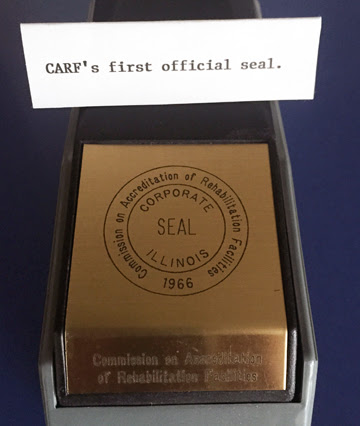
CARF is incorporated
The Commission on Accreditation of Rehabilitation Facilities was incorporated in Illinois as a nonprofit organization on September 27, 1966. Incorporation papers named nine directors, including one from Canada.
1969
CARF accredits its first program in Canada, St. Michael’s Hospital, Vancouver
1970
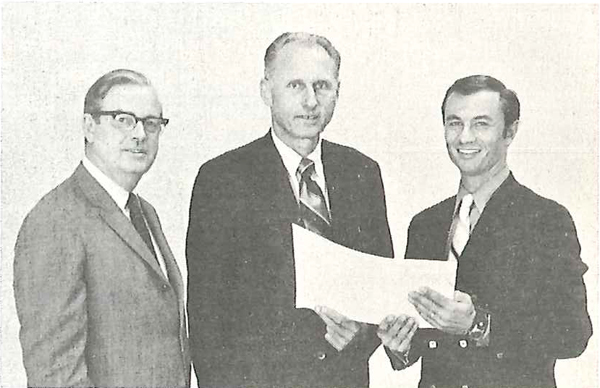
100th Survey
The Rancho Los Amigos Hospital in Downey, CA, marked the 100th site survey of a rehabilitation facility by CARF. Eugene Erickson (center) accepted the Certificate of Accreditation from William Page (left), Chairman of the CARF Board of Trustees, and Alan Toppel (right), CARF’s Program Director.
The Council of State Administrators of Vocational Rehabilitation passed a resolution requiring CARF accreditation of all rehabilitation providers. This was one of the key developments in the history of the Commission.
1971
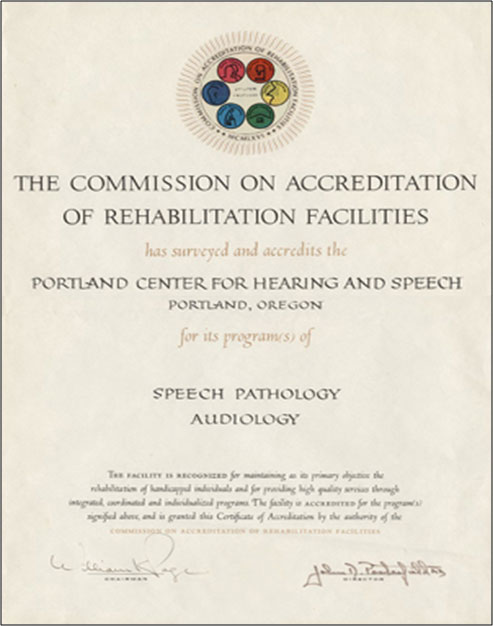
A pre-1971 accreditation certificate
A calligrapher hand-penned the provider and program names and each certificate was signed by JCAH Director John D. Porterfield, M.D.
1974
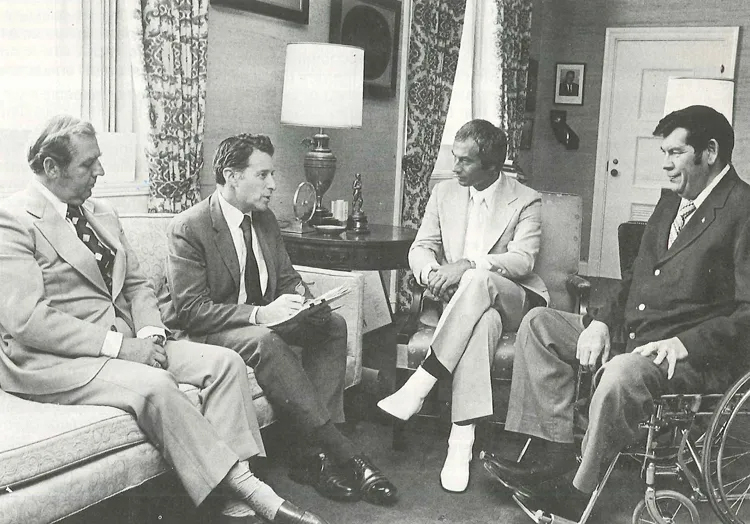
Active Communications
A meeting to discuss rehabilitation’s unique and decisive efforts in program evaluation, standards of performance, and accreditation. (Left to right) Dr. Andrew S. Adams, Commissioner of Rehabilitation Services; Caspar W. Weinberger, Secretary of Health, Education and Welfare [later renamed the Department of Health and Human Services]; Alan H. Toppel, Executive Director of CARF; and Ray R. Seitz, Vice Chairman of the CARF Board of Trustees.
1976
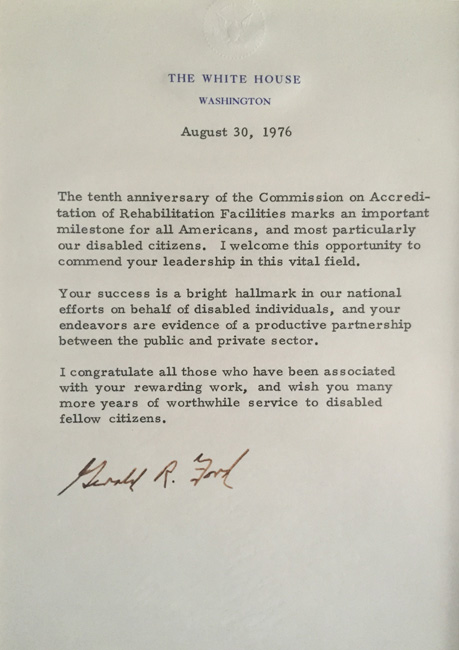
10th Anniversary
CARF celebrated its first 10 years of service and received a special congratulatory letter from U.S. President Gerald Ford commending the organization on this “important milestone for all Americans, and most particularly our disabled citizens. I welcome this opportunity to commend your leadership in this vital field.”
There are more than 850 organizations with accredited programs/services at nearly 1,900 locations.
1979
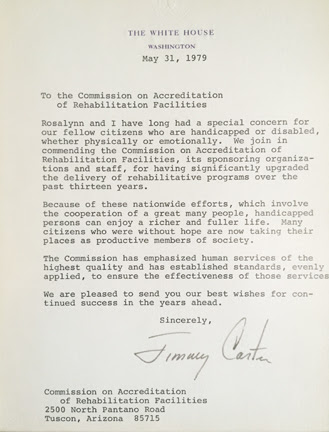
May
President Jimmy Carter recognized CARF for its significant efforts to upgrade the delivery of rehabilitation services to the nation’s citizens with disabilities.
1979
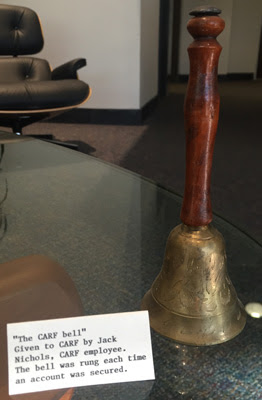
A six-inch engraved brass bell, brought to CARF International by Associate Director Jack L. Nichols, became part of CARF lore, rung in the office each time a survey application arrived. Nichols later continued serving CARF as a surveyor for Employment and Community Services until March 2016.
1981
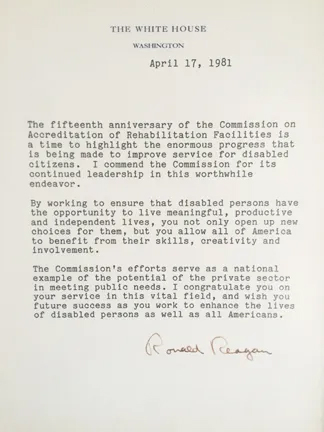
15th Anniversary
President Ronald Reagan wrote on the occasion of CARF’s fifteenth anniversary stating, “The Commission’s efforts serve as a national example of the potential of the private sector in meeting public needs”.
1986
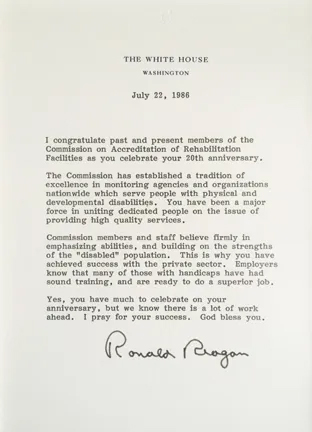
20th Anniversary
Standards for Respite Programs and Alcoholism and Drug Abuse Treatment Programs were introduced. President Ronald Reagan wrote for the twentieth anniversary, “The Commission has established a tradition of excellence in monitoring agencies and organizations nationwide which serve people with physical and developmental disabilities”.
1991

25th Anniversary
On 25th anniversary of CARF International, George H. W. Bush congratulated CARF International for helping open doors of opportunity for Americans with disabilities by promoting excellence in rehabilitation services.
The number of accredited programs/services reaches more than 3,000 in the U.S., Puerto Rico, and Canada.
1992
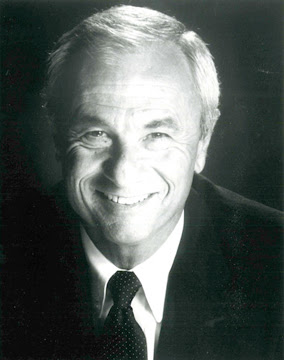
Alan H. Toppel, Executive Director
Alan H. Toppel retired after more than 20 years of service with CARF.
1995
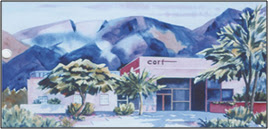
CARF published separate volumes of standards for its three divisions: Behavioral Health, Employment and Community Support, and Medical Rehabilitation.
CARF purchased its first office building at 4891 E. Grant Road in Tucson, AZ.
1996

30th Anniversary
CARF published the first edition of the Accreditation Sourcebook.
In the Medical Rehabilitation Division, standards for a new program area, Home- and Community-Based Rehabilitation Programs, went into effect, along with revised standards in the areas of Brain Injury Programs, both Comprehensive Inpatient and Community Integrative, and Spinal Cord Rehabilitation System of Care.
In its 30th year of operation, CARF accredited its first program in Europe.
2000
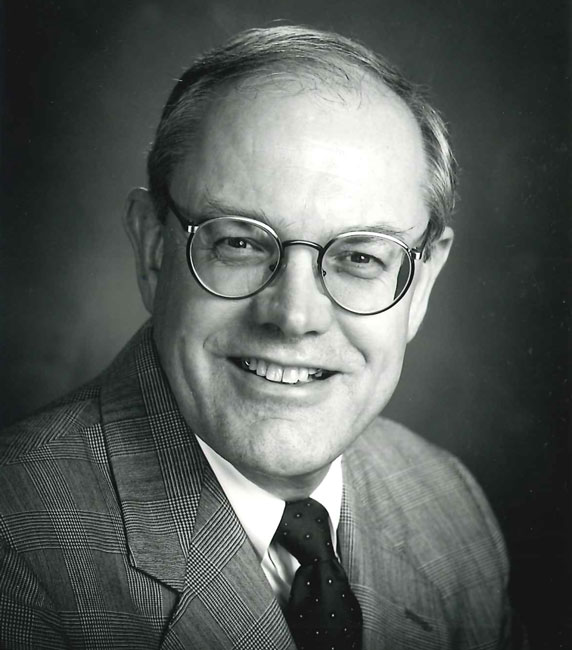
Don Galvin, Ph.D.
CARF President/CEO Don H. Galvin, Ph.D. retired. Don was a tireless champion of independent living and employment opportunities for individuals with disabilities, providing congressional testimony and presenting at conferences in the U.S. and around the world.
CARF published a standards manual for Assisted Living programs.
2002
CARF Canada is incorporated in Edmonton, Alberta.
2003
CARF International acquired the Continuing Care Accreditation Commission, founded in 1985 by the American Association of Homes and Services for the Aging, expanding its ability to identify high-quality care providers across services ranging from children to older adults.
The public information policy was extended to include all units.
2006
40th Anniversary
CARF published the Aging Services Standards Manual for providers with Continuing Care Retirement Communities, Aging Services Networks, Adult Day Services, Assisted Living, or Stroke Specialty Programs.
There are nearly 5,000 organizations with accredited programs/services at 38,325 locations in more than 10 countries.
2007
uSPEQ® launched
uSPEQ is a turnkey data collection and reporting system from CARF International that gathers feedback from key stakeholders to support organizational well-being and performance improvement, including surveys on consumer experience and employee climate.
CARF launched its online customer portal, Customer Connect (customerconnect.carf.org).
2010
CARF accredited its first programs on the African continent.
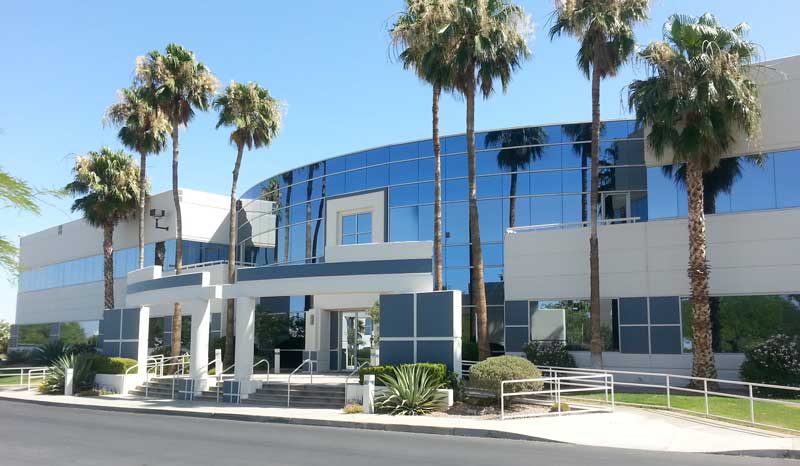
CARF headquarters office moved to 6951 E. Southpoint Road, Tucson, AZ.
2011
45th Anniversary
CARF logos were rebranded to include the ASPIRE® to Excellence tagline.
There are more than 6,425 organizations with accredited programs/services at over 47,350 locations worldwide.
2013
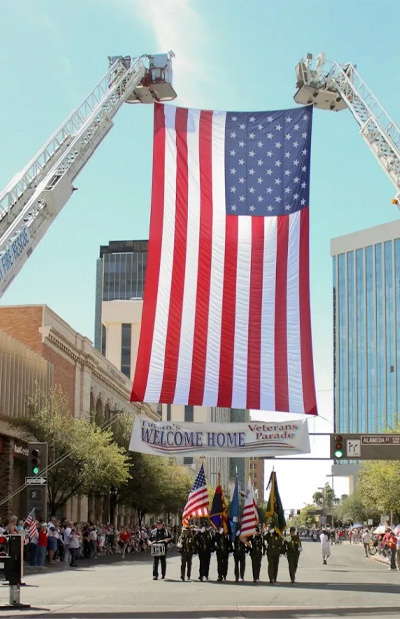
Alan Toppel passed away on April 22, 2013. His final crowning achievement was the idea, creation, and execution of “Tucson’s Welcome Home Veterans Parade” on March 31, 2012.
CARF introduced standards for Eating Disorder Treatment programs in the Behavioral Health accreditation area.
2016
50th Anniversary
There are nearly 7,000 organizations with accredited programs/services at more than 52,300 locations worldwide.
CARF celebrated 50 years of enhancing lives and services for the persons served.
2016
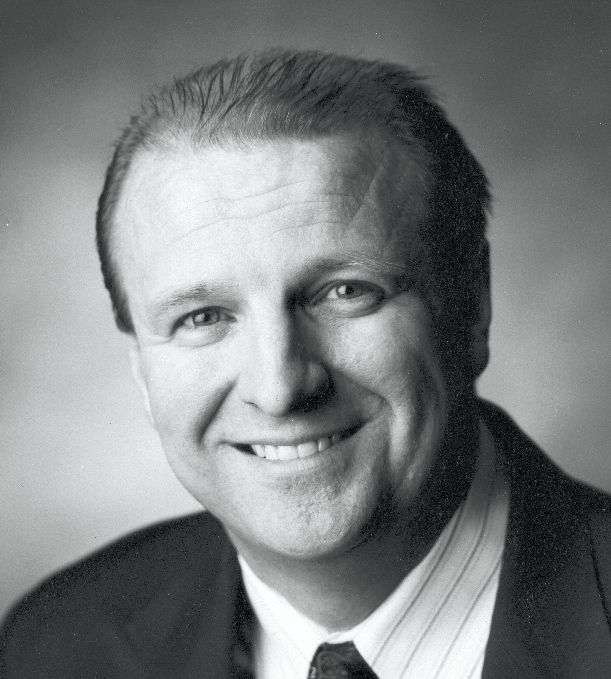
Brian J. Boon Ph.D.
Under the leadership of Brian J. Boon, CARF International expanded globally, broadened accreditation into new human service fields, strengthened its Washington, D.C., presence, modernized operations through digital innovations, and streamlined governance and accreditation processes.
2016
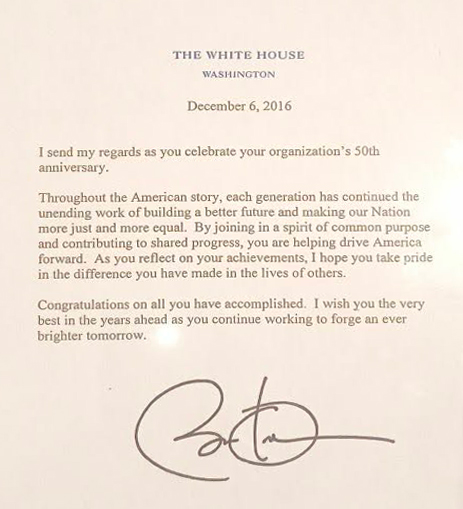
U.S. President Barack Obama sent a letter congratulating CARF International on its 50th anniversary.
2020
CARF partnered with the American Society of Addiction Medicine (ASAM) and began offering ASAM Levels of Care certification of residential substance use disorder treatment services.
2023
CARF launched a newly redesigned user-centric website at carf.org.
Michael J. Connolly, D.O., joins CARF as its first Chief Medical Officer to provide medical leadership across all accreditation areas.
CARF designed standards for Certified Community Behavioral Health Clinics (CCBHCs) based on the SAMHSA criteria and began offering accreditation for CCBHCs.

Impressively long-time organizations weigh in on accreditation
As CARF International approaches its 60th anniversary in 2026, there are several organizations that have been and remain accredited since CARF’s early years.
Persons served artwork showcase
This video series features artwork created by persons served at CARF International-accredited programs and highlights the connection between creative arts engagement and positive health outcomes.

Volume 1

Volume 2

Volume 3

Volume 4

Volume 5

Volume 6
Guestbook
How has CARF accreditation impacted you, your organization, or the people you serve? Sign the guestbook and let us know!
Organization name: Amivie Accredited program(s): ESC
Comment:
So excited to be in Arizona at this awesome conference!
Name: Barb NamettOrganization name: Retired Accredited program(s): BH
Comment:
Wonderful celebration!
Name: cathy ellisOrganization name: CARF Accredited program(s): Medical Rehabilitation
Comment:
As a CARF Board member, later an employee, and earlier as a provider in CARF accredited programs, the person served consistently was the moral owner of CARF International. I was honored to serve in these roles-CARF enriched my life beyond measure. I am immensely grateful for surveyors, colleagues, leaders and countless persons served.
Name: Tonie SchmidtOrganization name: Goodwill Industries of the Inland Northwest SOAR program Accredited program(s): Work Force and Community Services, SSVF
Comment:
CARF has set and continued to raise standards for the individuals served and Stakeholders. It is a wonderful thing to be part of!
Name: Jennifer ChenaultOrganization name: Marsh McLennan Accredited program(s):
Comment:
Congratulations on 60 Years! Incredible Milestone- it’s been a pleasure to work with you,
Besr wishes,
Jennifer
Organization name: UAB Spain Rehabilitation Center Accredited program(s):
Comment:
Congratulations, Brian, and team for your success and continued dedication to quality for persons served.
Name: Jenny SavageOrganization name: Alabama Institute for Deaf and Blind Accredited program(s): Community Employment Services, Vocational Evaluation, Assistive Technology & Vision Rehab
Comment:
I have been a CARF surveyor for 21 years, and have worked at CARF accredited agencies for 29 years. What CARF has meant to the quality and improvment of our services and programs during all of that time is priceless. I’m very grateful. Thank you and happy anniversary!
Name: Heather RoesnerOrganization name: Lookout Mountain Community Services dba Bridge Health Accredited program(s):
Comment:
Congratulations!
Name: Jacqueline LampleyOrganization name: Harbor House Chemical Dependency Service Accredited program(s): BH-Residential
Comment:
Begin CARF accredited since 2011 has positively impacted our organization by strengthening our culture of quality, accountability and person-centered care which is important for a 53-year-old nonprofit facility in Mississippi.
Name: Kara ClovisOrganization name: Audrain Developmental Disability Services Accredited program(s): Community Housing, Community Integration, Family Services, Service Coordination, Support Living
Comment:
Congratulations to CARF International on 60 years of inspiring commitment to quality, accountability, and service excellence. Your unwavering dedication to improving the lives of individuals and communities around the world has set a meaningful standard across health and human services.
Over the decades, CARF has empowered organizations to grow stronger, deliver better outcomes, and uphold the dignity and well-being of those they serve. This milestone is a testament not only to your vision, but to the countless professionals and partners who carry that mission forward every day.
Wishing CARF continued success in shaping a future built on quality, innovation, and compassion. Here’s to the next 60 years of impact and progress!
Name: Kristy ConklinOrganization name: Cecil Community Recovery Center Accredited program(s): Cecil Community Recovery Center. Grasonville Health Services
Comment:
What a great learning opportunity.
Name: Dr. Frank ChikaOrganization name: COO Accredited program(s): Turning Point Clinic, Baltimore, Maryland
Comment:
Thank you for your services!
Name: Dr. Alyaa AljasmiOrganization name: Family Care Authority Accredited program(s): Halfway houses – FCA
Comment:
Congratulations on CARF’s 60th Anniversary. We are proud to be CARF-accredited for our Halfway Houses and Reintegration Program in Abu Dhabi in United Arab Emirates for three years, achieving accreditation with zero recommendations. CARF standards have significantly strengthened our service quality, enhanced our program outcomes, and supported continuous improvement in the reintegration journey of the individuals we serve. We deeply value CARF’s guidance in helping us maintain excellence and person-centered care.
Name: Jonathan NeumanOrganization name: Aviv Recovery Accredited program(s): IOP
Comment:
Congratulations! Your impact on the behavorial health industry is beyond words. You have helped improved the lives of so many through their trying times.
Name: Kristi ProvuncherOrganization name: Carpenter Hall, LLC dba Zinnia Exeter Accredited program(s):
Comment:
Happy Anniversary to the CARF team! 🎉
On behalf of all of us at Zinnia Exeter, thank you for your dedication, guidance, and commitment to quality care and continuous improvement. We appreciate the important work you do to help organizations like ours deliver the highest standards of service to those we serve. Wishing you continued success and many more years of making a positive impact!
Name: Margaret CruzOrganization name: Florida Parishes Human Services Authority Accredited program(s): Adult and Youth Behavioral Health Services
Comment:
CARF provides those boundaries that we do not need on most days as we serve with humility but also gives us security and reassurance when we are in doubt!
Name: Teresa FrisbyOrganization name: Southeast Arkansas Behavioral Healthcare System, Inc. Accredited program(s): Behavioral Outpatient, Crisis, Community Integration, Case Management
Comment:
I have worked for two agencies over the past 33 years and both are CARF certified. We strive for excellence and we have had consecutive 3-year accreditations. CARF helps us by providing a standard guideline to meet the standards for various payor sources including Medicaid and striving for excellence.
Name: Sarah KoppesOrganization name: Henry Ford Wyandotte Hospital Accredited program(s): Medical Rehabilitation & Stroke Specialty Program
Comment:
CARF elevates how we deliver care—ensuring it is consistent, high-quality, and outcomes-driven for the patients we serve.
Name: Luis MendexOrganization name: Niños Latinos Unidos, Inc. Accredited program(s): Foster Care and Adoption
Comment:
Congratulation on your 60th anniversary.
Your growth and success is inspirational and encouraging to keep our tasks and goals.
Thank you CARF
Name: Lorette HermanOrganization name: Alcoholism Center For Women, Inc. Accredited program(s): 3.1, 3.5, 2.1,1.0 and Enhanced Care Management
Comment:
We are very proud to have had CARF accreditation since 2018. All the standards have helped to ensure that we are offering our services at the highest level. Thank you for setting the bar high. Our clients deserve the best.
Name: Samuel J Alianell, MD PAOrganization name: Chronic Pain Recovery Center Accredited program(s): Chronic Pain Recovery Center
Comment:
Happy 60th Anniversary, CARF! Your rigorous standards and commitment to excellence have provided our facility with the framework to deliver the highest quality of person-centered care and continuously improve the lives of those we serve.
Name: Dani CorbinOrganization name: Skyline Center Inc Accredited program(s): Community Employment Services: Employment Supports, & Job Development, Community Housing, Community Integration, Organizational Emp0loyment Services & Supported Living
Comment:
Thank you CARF, You have helped us to continue to provide services that are beneficial to those we serve. Happy Anniversary!!
Name: Jonathan RobbOrganization name: Centre for Autism Services Alberta Accredited program(s):
Comment:
As a relatively new leader serving the Centre for Autism Services Alberta, I have been very impressed by the organization obtaining CARF accreditation, which demonstrates a commitment to high-quality service delivery and improves client outcomes. We have been growing in sustainable and focused ways and am delighted with the support provided by CARF and their staff and offerings. Congrats on your 60th anniversary and looking forward to our continued partnership.
Name: Martha PhelpsOrganization name: Therapeutic Health Endeavors Accredited program(s): MH and SUD
Comment:
I have been accredited through CARF for 6 years and received another 3 year accreditation this year. The accreditation is beneficial to our shareholders who have a good understanding of our commitment to safety and ethical practice principles.
Name: Angela DavisOrganization name: Benchmark PT/Upstream Rehabilitation Accredited program(s):
Comment:
Upstream has IPR accredited programs in other states—not in Georgia
CARF’s commitment to clinical excellence and it’s focus on Person served improves all programs so that outcomes are more easily achieved and the uniqueness of the program is highlighted.
Name: Laurel BeyerOrganization name: Community Connection Healthcare Accredited program(s): Employment and Community Service
Comment:
Community Connection Healthcare provides a range of home care services across Massachusetts focusing on MassHealth’s Adult Foster Care – AFC and Group Adult Foster Care – GAFC programs to help consumers live independently in their own home. We consider our CARF accreditation to be the gold standard in providing top quality home health care. The CARF Manual provides the guidelines that keep us on track in maintaining high standards of business operations, staff training, home health care and service.
Name: Patricia SampsonOrganization name: Community Rehabilitation Center, Inc Accredited program(s): Behavioral Health Services, Outpatient Treatment Mental Health and Substance Use/Addiction with Peer Support, Criminal Justice Outpatient Treatment with Peer Support Substance Use/Addiction , Opioid Treatment Addictions Pharmacotherapy
Comment:
We sincerely acknowledge and congratulate CARF International on the celebration of its 60th Anniversary. The organization is committed to promoting quality and excellence throughout the health and human services community. Within the 60 years, CARF with contribution of it’s leadership, has positively impacted other organizations with maintaining the highest standards of care and professionalism.
We extend our heartfelt gratitude and well wishes to CARF’s leadership team and supported staff on this milestone.
Community Rehabilitation Center, Inc.
Name: Nola DavisOrganization name: YMCA Bettye J. McCormick Center Accredited program(s): Adult Day Services
Comment:
I have been CARF accredited for many years. When I first reached out, I was very skeptical about where our program would stand among so many other services. I had never surveyed like this before so you can imagine my anxiety. Let me tell you, the experience was very educating. The surveyors were helpful and answered so many questions. They led me to resources I would have never found on my own. Today, several surveys under my belt, I still see every one of them as a learning experience. If I could give any ADS a solid piece of advice, it would be to experience the CARF process. You will learn something new. You will meet kind, knowledgeable surveyors who are there to assist your program and staff to utilize best practices to achieve the best results for those you serve. Do yourself a favor look into CARF today!
Name: Dr. Michael Wirth-DavisOrganization name: Goodwill-Easter Seals Minnesota Accredited program(s): Community Employment Services: Employment Supports
Comment:
Community Employment Services: Job Development
Comprehensive Benefits Planning
Employment Development Services
Employment Planning Services
Employment Skills Training Services
Governance Standards Applied
Organization name: Elite Care Service Inc Accredited program(s): Saiop. Sacot. And peer programs
Comment:
Congratulations on this great achievement
Name: Deanna DavidOrganization name: Goodwill Industries of the Redwood Empire Accredited program(s): Supported Employment and Supported Employment Paid Internship Programs
Comment:
Congratulations on your 60th Anniversary and thank you for setting the standards that help guide organizations like ours in providing exceptional service to our clients and community.
Name: Ann TinusOrganization name: Access therapeutics Accredited program(s): Bh
Comment:
I’m looking forward to the upcoming September training for potential surveyors.
Name: Jim AllbaughOrganization name: Carey Services, Inc. Accredited program(s): Community Employment Services: Employment Supports, Community Employment Services: Job Development, Community Integration, Supported Living
Comment:
Congratulations to the entire CARF team on your 60th anniversary. We are proud to be a CARF accredited organization, and we celebrate with you with this great achievement. Thank you for the part you have played that allows Carey Services, Inc. in Marion, Indiana to be a high quality, high impact provider of services and supports for people with intellectual and developmental disabilities. Enjoy your celebration! – Jim Allbaugh, President/CEO
Name: Steven ScottOrganization name: HOPESS Accredited program(s): SUD Behavioral Health Residential Facility
Comment:
Thank you for your continued leadership and advocacy to promote and improve substance use disorder treatment and best outcomes. Congratulations on your 60th anniversary!
Name: Jody WilsonOrganization name: Anchor Addiction and Wellness Accredited program(s): OTP
Comment:
It is truly an honor to be part of this very special occasion as we celebrate the 60th anniversary of this remarkable program. Sixty years represents not only longevity, but a deep and lasting commitment to serving individuals, families, and communities with purpose, compassion, and excellence.
On a personal level, this program has had a profound impact on me. It has strengthened my professional growth, deepened my understanding of client needs, and enhanced my ability to serve with empathy and effectiveness. Through the knowledge, resources, and support it provides, I am better equipped to meet challenges and deliver meaningful outcomes for those we serve. I am confident that this program will continue to grow, innovate, and serve future generations with the same dedication that has defined its first 60 years.
Today, we celebrate not only a milestone, but a legacy—one built on service, commitment, and care.
Organization name: Willis Knighton Health Accredited program(s): Inpatient Rehabilitation Programs – Hospital Adults and Stroke Specialty Program Adults, and Interdisciplinary Outpatient Medical Rehabilitation Programs Adults, Children and Adolescents
Comment:
Our organization has been accredited since 1986 and we are proud to be the only accredited program in the Northen part of the state. While other organizations seek other accreditations, we have chosen to continue with CARF accreditation knowing the standards are industry driven, peer reviewed, and bring value to the quality of our programs. Congratulations on 60 years of providing the framework for the highest quality of care for those we serve!
Name: Lynne HastieOrganization name: A New Leaf Accredited program(s): A New Leaf’s East Valley Men’s Center
Comment:
A New Leaf’s East Valley Men’s Center is proud to partner with CARF, whose accreditation reflects our commitment to providing high-quality, person-centered care that meets the needs of those we serve. We value CARF’s collaborative, consultative approach, which supports continuous improvement and service excellence.
Name: Timothy MyersOrganization name: Baptist Senior Family Accredited program(s): CCRC
Comment:
A great success story by all. Absorbing CCAC many years ago and continuing to benefit the long-term care industry is something that everyone involved can be proud of.
Best wishes for another 60 years of growth and service.
Name: Lisa BatesOrganization name: Williamsburg Landing Accredited program(s): CCRC
Comment:
We are so proud to have achieved the 5 year accreditation from CARF. The program has strengthened our program and we always learn something from the process. Happy Anniversary and thank you for all you do.
Name: Emily Grace BrunsonOrganization name: Wiregrass Rehabilitation Center Inc. Accredited program(s): Community Employment Services and Comprehensive Vocational Evaluation Services
Comment:
This recognition represents the highest level of accreditation that CARF offers and reflects WRC’s commitment to meeting and exceeding international quality standards while continuing to support individuals with disabilities in finding and maintaining meaningful employment. WRC is especially proud to share that we received no recommendations on our recent CARF survey report. This milestone highlights our team’s dedication to excellence and our continued commitment to the individuals and communities we serve. This three-year accreditation applies to WRC’s Community Employment Services, including Employment Supports, Job Development, and Comprehensive Vocational Evaluation Services. Thank you to CARF for this recognition, and thank you to the Wiregrass community for allowing us to continue showing what a difference a job makes!
Name: Jo WilliamsonOrganization name: JFK MATP Accredited program(s): Medication Assisted Treatment
Comment:
Thank you for providing constructive consultation with our Medication Assisted Treatment Program since 2017. We look forward to our continued partnership with you.
Sincerely,
Jo Williamson, President and CEO
Organization name: Hospital Banco de Seguros del Estado Accredited program(s): Inpatient, Pain and Occupational
Comment:
Congratulations! I’m really proud to be part of this community.
All the best!
Organization name: Private Consultant Accredited program(s):
Comment:
CARF has long been a catalyst for change, resulting in true best practices and ultimate service excellence for individuals with cognitive and physical barriers to employment and daily living. As a service provider, service recipient and as a 34-year CARF surveyor, I have watched for decades CARF’s evolution to champion cutting edge services. This evolution has created a world of quality services that has created accountability and a means to authentic discovery of what each person served wants for their own lives. Thanks, CARF for your willingness and dedication to see this mission through from the darker, early days of canned, cookie-cutter, service delivery to the ever-increasing customized service delivery we see developing each and every day. Here’s to another 60 amazing years!
Name: Ali AL-MemarOrganization name: Ascot Rehabilitation Ltd Accredited program(s): Rehabilitation
Comment:
Congratulations for achieving this milestone and we are proud of being part of your family
Name: Dan NieberdingOrganization name: Life Renewal Services, Inc. Accredited program(s): Outpatient & Community Integration
Comment:
Way to go CARF! Here’s to another 60 years & beyond!
Name: Crystal JanesOrganization name: Lumera Healthcare Accredited program(s):
Comment:
I am very proud that my organization is part of the CARF accrediting process. I am looking forward to my journey as a surveyor with such an outstanding team.
Name: Brenda CabreraOrganization name: Hospital Banco de Seguros del Estado Accredited program(s): Inpatient Rehabilitation Programs, Interdisciplinary Pain Rehabilitation Programs, Occupational Rehabilitation Programs
Comment:
La experiencia de acreditación CARF nos ha permitido ordenar, medir y mejorar, siempre con el foco puesto en las personas, procurando la excelencia desde una gestión más humana y alineada con estándares internacionales que han marcado nuestra hoja de ruta. En lo personal, ha sido un proceso exigente, enriquecedor y de gran aprendizaje que refuerza el compromiso con la calidad y la mejora continua. ¡Felicidades por estos 60 años!
Name: Cynthia Savage-BrownOrganization name: Accredited program(s):
Comment:
Congratulations to CARF International on this 60-year anniversary. Being a CARF surveyor for 27 years has been a noteworthy asset to my professional career as a clinical social worker with a primary focus on quality assurance and improvement. I’m forever indebted to Habilitative Systems, Inc. – Chicago for recommending me. Every single survey I’ve conducted has exposed me to an innovative technique, strategy or new tool that I’ve applied in my own work. CARF staff enthusiastically support the success of the surveyor cadre with incredible skill, integrity and genuine investment in enhancing the lives of persons served. When organizations ask about the value of CARF accreditation, I reply that it is a symbol of excellence and commitment to continuous quality improvement, which inspires persons served and other stakeholders to have trust and confidence in your services.
Name: Jim CurtinOrganization name: CCHP Accredited program(s): OP OTP
Comment:
The people at CARF, are CARF, and that’s why it’s such an outstanding organization!
Name: Dr. Bruno CamaggiOrganization name: Teleton Accredited program(s):
Comment:
On behalf of Teletón Chile, I would like to warmly congratulate CARF on its 60th anniversary. As an institution with four accredited centers we feel proud to be part of this global ecosystem committed to quality, learning, and continuous improvement. CARF’s model has inspired us to keep strengthening our services for our patients and families, with the dream and commitment to continue growing, accrediting more centers, and moving toward the accreditation of our highest-impact center in Chile in 2027. Congratulations on this important milestone, and thank you for continuing to lead a path that helps organizations like ours become better every day.
Name: Lynn HaugenOrganization name: LKR Care Excellence Consulting Accredited program(s):
Comment:
So grateful for the opportunity to work with CARF, an organization that brings such a thoughtful and consultative approach to accreditation. Their commitment to partnership, learning, and meaningful improvement creates an environment where organizations feel supported and empowered. It’s truly a privilege to engage with a group that upholds such high standards while fostering collaboration and growth.
Name: Christina BisanzOrganization name: CHATS-Community & Home Assistance to Seniors Accredited program(s): AS, ECS
Comment:
CHATS-Community & Home Assistance to Seniors, is proud to be one of many international community based seniors serving organizations accredited by CARF. Through the rigor required to continuously conform with the AS and ECS standards, our accreditation shows CHATS is doing it right—delivering high-quality, client-focused care people can trust, while constantly pushing to get even better.
Name: Trish KraleOrganization name: Holland Christian Homes Accredited program(s): Assisted Living, Independent Senior Living, Person-Centered Long-Term Care Community
Comment:
Congratulations on your 60th anniversary! Holland Christian Homes is pleased to be accredited by CARF and we look forward to continuing with CARF on our accreditation and continuous improvement journey.
Name: Patricia WilliamsOrganization name: BCD/Hoover Treatment Center Accredited program(s): Residential & Outpatient Treatment Programs
Comment:
Hoover Treatment Center’s 15-year relationship with CARF International has resulted in a more consistent, efficient, and effective delivery of client services. Due to CARF inspired refinement of program evaluation and improvement planning and implementation processes, HTC service delivery outcomes have become more relevant and impressive.
Name: Jose FuentesOrganization name: Advantage Healthcare Systems Accredited program(s): same
Comment:
hurrah!
Name: Donald DewOrganization name: Habilitative Systems, Inc. Accredited program(s): Case Management Services Coordination Integrated IDD Mental Health Adults Case Management Services Coordination Integrated IDD Mental Health Children and Adolescents Case Management Services Coordination Integrated SUD Mental Health Adults Case Management Services Coordination Mental Health Adults Case Management Services Coordination Mental Health Children and Adolescents Community Housing Integrated SUD Mental Health Adults Community Housing Mental Health Adults Community Housing Substance Use Disorders Addictions Adults Diversion Intervention Family Services Children and Adolescents Intensive Outpatient Treatment: Integrated SUD Mental Health Adults Intensive Outpatient Treatment: Substance Use Disorders Addictions Adults Outpatient Treatment Mental Health Adults Outpatient Treatment Mental Health Children and Adolescents Outpatient Treatment: Substance Use Disorders Addictions Adults Residential Treatment Integrated IDD Mental Health Adults Community Integration Organizational Employme nt Services Governance Standards Applied
Comment:
Congratulations on an impactful 60 years of quality services!
Name: Kelly GentryOrganization name: Cone Health Accredited program(s): CIIRP, Brain Injury, Stroke
Comment:
We are deeply grateful for the CARF International survey process. Preparing for the survey challenges us to examine our program with greater intentionality, while strengthening our commitment to delivering the highest quality care to those we serve.
The survey process also fosters meaningful engagement with our stakeholders while guiding us to thoughtfully analyze our data. This deliberate reflection not only enhances accountability but also drives continuous quality improvement across our program. As a result, we are better equipped to provide services that are effective, responsive, and grounded in person-centered care.
Organization name: Swan Community Services Accredited program(s): Community Integration, Host Family/Shared Living Services
Comment:
Congratulations on 60 years!
Name: Matt JohnsonOrganization name: Summit Youth Academy Accredited program(s): Child and Youth Services
Comment:
Thank You
Name: Thomas BuckleyOrganization name: The Roland Center Accredited program(s): Adult Day, Dementia, Autism, Employment
Comment:
CARF is the preeminent standards setting organization in the world with extraordinary administrators, staff and especially the cadre of surveyors. I am grateful to serve on the CARF board of directors and can witness the incredible life changing services and support provided to the persons served. I hope the next 60 years are as meaningful as the first 60 years. Congratulations.
Name: Tom HeathOrganization name: CARF Board of Directors Accredited program(s):
Comment:
CARF provides amazing service to the community
Name: Richard ForkoshOrganization name: Retired: United Cerebral Palsy Heartland Accredited program(s): ECS, CYS,
Comment:
Congratulations on 60 years of meaningful and high quality accreditation services supporting thousands of organizations and many tens of thousands of persons served. Our organization has been continuously accredited by CARF for the past 43 years. The organization has experienced significant growth and change in its programs and services offerings incorporating the standards and focus on persons served. The Board of Directors used the CARF accreditation process to help support its governance and oversight responsibilities.
Here is to the next 60 years of meaningful and highly relevant accreditation services both nationally and abroad.
Organization name: Cornell University Accredited program(s):
Comment:
It is a privilege to serve on the board of CARF, an organization that has contributed so significantly to the quality standards of services provided to individuals with disabilities both nationally and beyond.
Name: Leela BaggettOrganization name: Accredited program(s):
Comment:
As a Board member, I am incredibly proud to celebrate the 60th anniversary of CARF and the extraordinary impact this organization has made across the globe. CARF remains dedicated to advancing quality and excellence to enhance the lives of persons served. Thank you to everyone who has contributed to CARF’s legacy and mission!
Name: Tyra TruebloodOrganization name: Gibault Inc. Accredited program(s):
Comment:
Congratulations on your 60th!
Name: Kevin RobertsonOrganization name: PowderHorn Consulting LLC Accredited program(s):
Comment:
It’s an honor to be a current CARF administrative surveyor and also to work with organizations as a consultant with PowderHorn. Congratulations to both!
Name: Tom SefcikOrganization name: PowderHorn Consulting Accredited program(s):
Comment:
In the 21 years that I have been associated with CARF and my 5 years as a CARF Surveyor, I have seen organizations improve in the quality of their services, which has positively impacted the lives of the persons that they serve.
Name: JAMILA AITHAMMOUSAIDOrganization name: Caring Hearts Services LLC Accredited program(s): AFC
Comment:
thank you for your business
Name: Danette MillerOrganization name: Community Action Commission of Fayette County Accredited program(s): Peer Support
Comment:
Congratulations! CARF has enhanced our program by making it more credible to other stakeholders in the community. We appreciate the guidance and support we have received.
Name: Joy ChizobaOrganization name: Chinyere Accredited program(s): Yes
Comment:
Enugu state
Name: Marvel LaroseOrganization name: Caridad Independent Living, LLC Accredited program(s): AFC, GAFC
Comment:
As an Adult Foster Care provider, CARF accreditation has guided us in building a culture of quality, safety, and continuous improvement. It has strengthened our policies, staff development, and commitment to delivering compassionate, person-centered care. Congratulations on your 60th anniversary!
Name: CHRISTINE STUCKEYOrganization name: Safe Space Oasis Accredited program(s): N/A
Comment:
HAPPY BIRTHDAY
Name: Sushil RoopaniOrganization name: ROOPEX living Accredited program(s): B
Comment:
Happy to hear.
Name: Fredrika MurrillOrganization name: POA Living LLC Accredited program(s): Residential Treatment Children and Adolescent
Comment:
The process assisted our agency with raising our administrative process and program implementation.
Name: Jennifer StukeyOrganization name: NDTC, Inc. Accredited program(s): OTP
Comment:
Congratulations!
Name: Stephanie StephanieOrganization name: Resourceful Solutions II Accredited program(s): RBHS/Mental health
Comment:
need survey
Name: DR ASIF BASHAOrganization name: SHEIKH KHALIFA HOSPITAL FUJAIRAH Accredited program(s): CARF
Comment:
Our CARF journey is inspiring us to strengthen quality, safety, person-centered care, and continuous improvement across our organization. As we prepare for accreditation, we are building stronger processes and teamwork with the ultimate goal of delivering better outcomes and experiences for the people we serve.
Name: Michael WallOrganization name: ARCA Accredited program(s):
Comment:
I’ve loved CARF since my first survey and certificate in 1994. I look forward to helping complete surveys on your behalf in the near future. Happy 60th and well deserved!! ♥
Name: James AvramopoulosOrganization name: Doctors Without Borders Accredited program(s): International health
Comment:
International health
Name: Kristina StanleyOrganization name: TDCSS Accredited program(s): ECS & CYS
Comment:
Congratulations on 60 years of helping organizations like TDCSS achieve their goals and strive for excellence in their service provision!
Name: James AbergOrganization name: Neuro RehabCare Accredited program(s): Medical Rehabilitation: Residential and BI Speciality
Comment:
I was a CARF ECS surveyor from 1986 to 2016. Trained in Chicago at the time. Have many fond memories of my CARF years. Presented at a number of CARF winter conferences, and did some surveyor training. Congratulations CARF! Jim Aberg
Name: Stephanie CherryOrganization name: Aramark Accredited program(s): Supervisor
Comment:
Tell the inmates how to cook clean and help prepare the food.
Name: Benjamin BruceOrganization name: HopeTree Family Services Accredited program(s):
Comment:
Congratulations to CARF International on 60 years of helping organizations aspire to excellence. At HopeTree, we view accreditation not as a destination, but as part of an ongoing journey of continuous improvement, accountability, and better outcomes for those we serve every day.
Name: EMAN ALEJAWIOrganization name: ABA Accredited program(s): Housing Bank
Comment:
EMAN BARAKAT MOHAMMED ALEJAWI
Jordan Irbid
Organization name: Accredited program(s): OPD program for adult, children and adoloscent
Comment:
CARF has truly been a game changer for rehabilitation facilities around the world. Having worked as a Quality Officer within a rehabilitation organization, I had the privilege of working closely with CARF standards and supporting the organization in maintaining and advancing these standards.
What makes CARF particularly distinctive is its comprehensive approach to quality. It goes far beyond monitoring KPIs, training records, or drill reports. CARF encourages organizations to understand the processes that drive their outcomes, how and why decisions are made, how different departments collaborate, and how areas such as legal, finance, health and safety, clinical care, and operations contribute to the overall quality and effectiveness of the organization.
For anyone who has worked closely with the CARF standards and manual, it becomes evident that CARF is not simply about achieving accreditation, it is about developing a culture of continuous quality improvement, accountability, and meaningful progress.
I believe that, in the years ahead, CARF principles may become an increasingly important part of the education and professional development of rehabilitation professionals worldwide, helping future practitioners understand that quality is an integral part of rehabilitation,not a separate function.
Being able to contribute to this journey has been a valuable professional experience for me. I am deeply inspired by CARF’s mission and hope that one day I will have the opportunity to contribute to it from another perspective as a CARF surveyor.
Wishing CARF many more years of transforming rehabilitation through excellence, integrity, and continuous improvement.
Name: Paulina LinnOrganization name: CARF International Accredited program(s): HQ
Comment:
Such an amazing milestone! I am honored to be part of CARF and its mission to serve!
Name: Michelle JohnstonOrganization name: CARF Accredited program(s):
Comment:
Happy to be part of the CARF family. Congrats to 60 years!! Cheers to many more.
Name: Larry ZookOrganization name: Landis Communities Accredited program(s): Continuing Care Retirement Community
Comment:
Landis Homes has been accredited continuously as a Continuing Care Retirement Community since 1994, and we highly value the impact accreditation has had in helping us to improve and maintain high quality service to residents and their families. Accreditation also provides leadership growth opportunities for team members who are engaged in the reaccreditation efforts. Contratulations to CARF International on your 60th anniversary!
Name: Jenny McCallionOrganization name: Access Supports for Living Accredited program(s): Clinics, PROS, Crisis
Comment:
As our agency grows, we continue to strive for excellence and our CARF accreditation is one way we do that. Congratulations on 60 years!
Name: TAKIWA BROWNOrganization name: IMPACT THERAPY, LLC Accredited program(s): Outpatient treatment
Comment:
Congratulations on 60 years of building excellence and setting high standards for organizations.
Name: Thomas BuckleyOrganization name: The Roland Center Accredited program(s): Adult Day, Dementia, Autism, Employment
Comment:
CARF International is the preeminent accrediting organization in the world celebrating 60 years of extraordinary growth and specialization in standards of care. Congratulations to the CARF International president, Brian Boon and the entire CARF team.
Name: Sandra FloresOrganization name: Abilene Absolute Recovery Solutions Accredited program(s): Opioid Treatment Program
Comment:
We appreciate all that you do, to assist use in maintaining a higher level of care.
Name: Teresa CrawfordOrganization name: Accredited program(s):
Comment:
I currently go to a methadone treatment clinic in Erie PA which is Carf accredited.
Name: Crystal BrileyOrganization name: Piece by Piece Wellness Accredited program(s):
Comment:
Congrats on this major accomplishment. Wishing you many more.